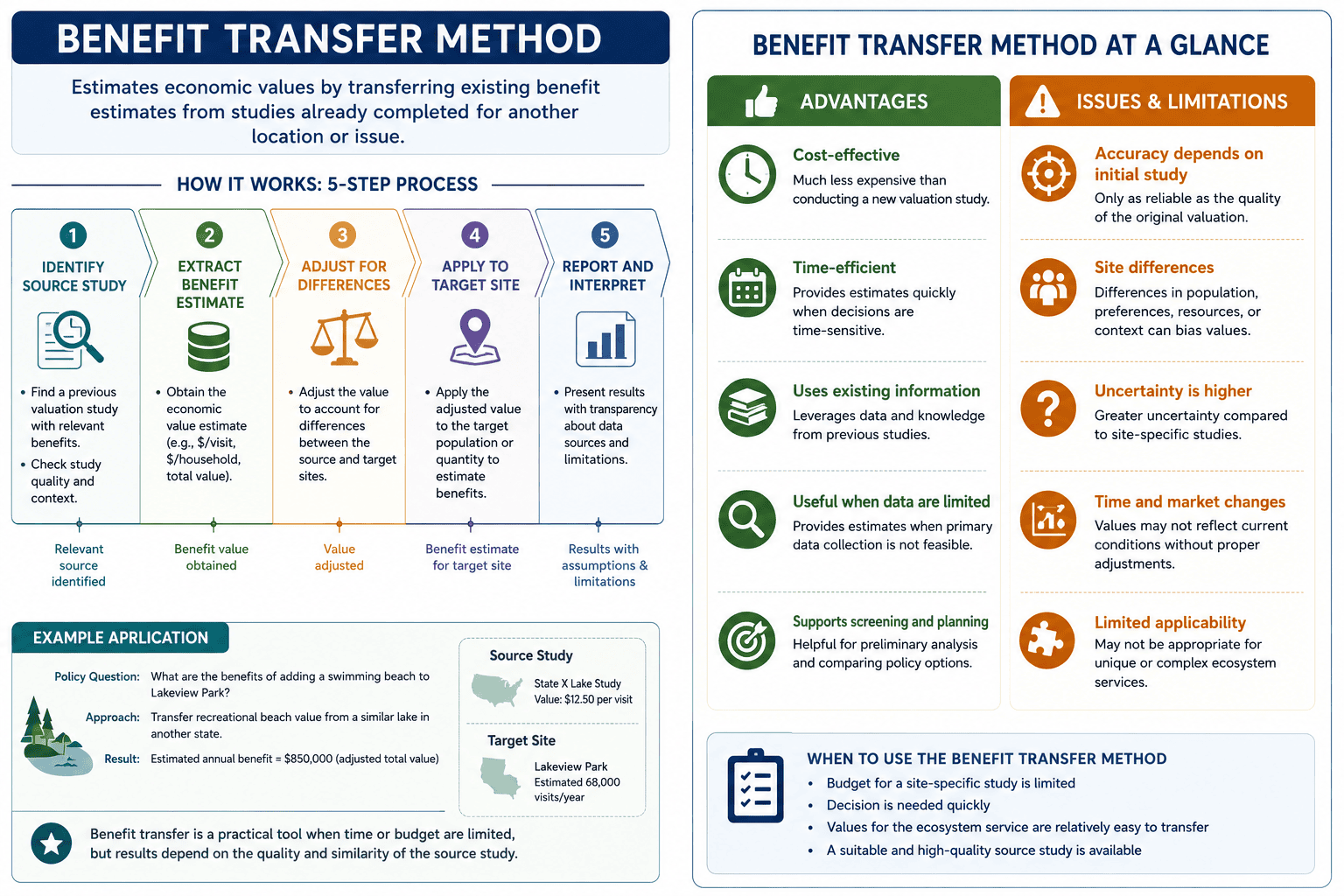
Benefit transfer or, more generally, value transfer, is not actually a valuation method. Rather, it is a set of techniques to estimate the economic value of non-market ecosystem services at a target site (the “policy site”, or site i) when an original valuation study is not feasible due to constraints. In such situations, benefit transfer techniques can be applied to transfer welfare measures for environmental resources, such as willingness to pay (WTP) estimates, from original valuation studies (“primary studies”) previously performed at other sites (the “study sites”, or sites j).
Benefit transfer is based on desk analysis of primary studies, allowing the avoidance of field study, so its main advantages come in the form of time and budget saving. The main disadvantage, as expected, is the higher likelihood and size of valuation errors, due to the inherent uncertainty in dealing with the differences between the study and the policy sites. In an ideal scenario, the policy site i and the study site j are well characterized and are known to be extremely similar in type, quality, extension, and condition, as well as socio-economic context, making the transfer of values a simple task. However, real scenarios hardly ever are so simple, requiring the application of more-or-less complex estimation methods.
Naturally, the quality of the output of benefit transfer techniques cannot be better than the quality of the input data, no matter the fanciness or precision of the applied transfer techniques. Note that even in the cases of poor data quality it might be a good idea to perform a simple benefit transfer analysis, at least as a screening test to assess the need of collecting primary data or carrying out an original valuation study.
Category:
Tool Types:
Output:
Target User:
Locations Tested:
Level of uncertainty:
Version:
Rights:
Publication:
Difficulty:
Skill Required:
Authors:
Tool Contributors:
Project general coordinator:
Project Scientific manager:
Project Manager: