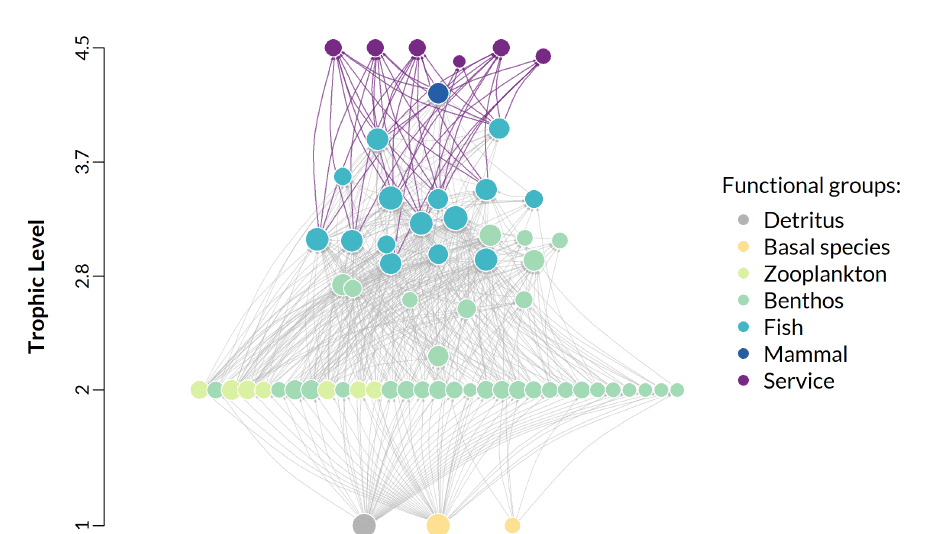
Ecological interaction networks consist of nodes (or vertices) and links (or edges) representing species in a community and the interactions among them. The interactions can represent feeding links, or trophic interactions, describing “who eats whom” in the food web. Trophic interactions represent a dimension of biodiversity that is central to the functioning and stability of marine ecosystems. The organisation of the network – its topological structure – can be described and quantified using different metrics. These can either be network-level metrics, describing e.g. the number of links and the connectance of the network, or species-level metrics, such as generality and vulnerability, which are properties that show some of the functional roles of different taxa. The feeding links can be binary or weighted, e.g., assigned an estimate of importance using bioenergetic modelling, taking advantage of allometric scaling laws to quantify metabolic rates. Interaction strength is here defined as energy flux, effectively a common currency of ecosystem functioning. Energy flux dynamics in networks elegantly link together biodiversity, structure, and ecosystem functioning, and many fluxes are further translatable to ecosystem services. In summary, flux-weighted interaction networks provide an approach with which one can examine shifts in biodiversity (species richness, composition, relative biomasses) and ecosystem functioning (flux of energy through the community) in changing marine ecosystems.
Category:
Tool Types:
Input:
Target User:
Level of uncertainty:
Version:
Rights:
Publication:
Difficulty:
Skill Required:
Authors:
Tool Contributors:
Project general coordinator:
Project Scientific manager:
Project Manager: