- Category: Economical
- Subcategory: Economic valuation of ecosystem services; Valuation of environmental goods & societal benefits
- Tool Type: Modeling approaches-Econometric model
- Input data: Respondent’s choices among different policy alternatives (for discrete choice studies)/ willingness to pay for a policy scenario (for contingent valuation studies). Socioeconomic information (such as gender, age, income, etc.) and attitudinal questions.
- Output: Willingness to pay (WTP) for a change in an environmental attribute or a scenario.
- Target users: Researchers / Trained practitioners
- Location tested: Gulf of Gdansk, Southern Gulf of Biscay
- Level of uncertainty: Confidence intervals can be estimated after the model estimation. Uncertainty is therefore quantifiable and context-specific.
- Version:
- Publication:
- Rights:
- Difficulty level of implementation: Complex
- Skill required (for method use): Knowledge of discrete choice models and the contingent valuation method, skill in using statistical software
- Authors:
- Task Leader: Carlo Fezzi.
- Authors: Nan Zhang, Marco Tomasi
- Tool contributors:
- Project general coordinator:
- Project Scientific manager:
- Project manager:
- Boyle K. (2017). Contingent Valuation in Practice. In Champ P.A., Boyle K., Brown T.C. (eds), A Primer on Non-market Valuation (pp.83–131). Dordrecht: Springer.
- Mitchell, R.C., Carson, R.T. (1989). Using Surveys to Value Public Goods: The Contingent Valuation Method. Resources for the Future, Washington DC.
- Riera P., Signorello G., Thiene M., Mahieu P.A., Navrud S., Kaval P., Rulleau B., Mavsar R., Madureira L., Meyerhoff J., Elsasser P., Notaro S., De Salvo M., Giergiczny M., Dragoi S. (2012). Non-market valuation of forest goods and services: Good practice guidelines. Journal of Forest Economics, 18(4), 259–270.
- Contact
- Name:
- Organization:
- Email:
Stated Preference Methods – SPM
Stated Preference (SP) methods are survey-based approaches to non-market valuation. A sample of the reference population is asked to complete a questionnaire where a good or service is offered in a hypothetical market, for example, the improvements in water quality or biodiversity associated with an intervention policy. Willingness to pay (WTP) for the good is then estimated using statistical procedures.
The main advantage of SP methods over Revealed Preference (RP) methods is that they allow the estimation of non-use and option values. Their main disadvantage is hypothetical bias since respondents state their preferences in a hypothetical market (Boyle, 2017). For example, respondents may provide an inaccurate WTP of hypothetical goods/services due to a lack of understanding or familiarity.
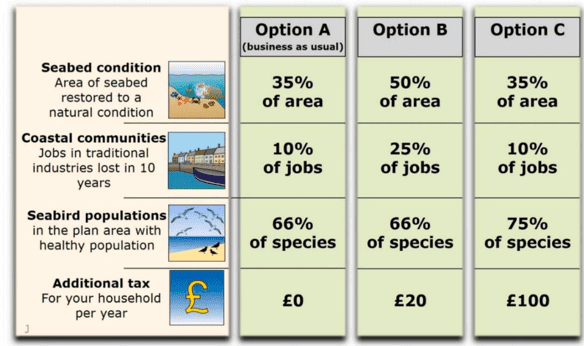
SP methods are categorized into Contingent Valuation (CV) and Discrete Choice Experiments (DCE). In CV surveys, people are asked to state their willingness to pay (WTP) or willingness to accept (WTA) for a hypothetical change in the provision of a good (Mitchell & Carson, 1989). In DCE surveys, respondents are asked to make choices over goods or policies, defined in terms of attributes and levels in hypothetical alternative scenarios. That is, CV considers the good (e.g., the non-market value of a beach) as a whole and DCE as a “bundle of attributes” (Riera et al., 2012).
- Availability / URL: