BEACH (Benefit Evaluation through Assessment of Component Habitats)
- Category: Economic model
- Subcategory: Valuation of environmental goods and societal benefits at local scales; and Ecosystem services & management
- Tool Type : Excel workbook
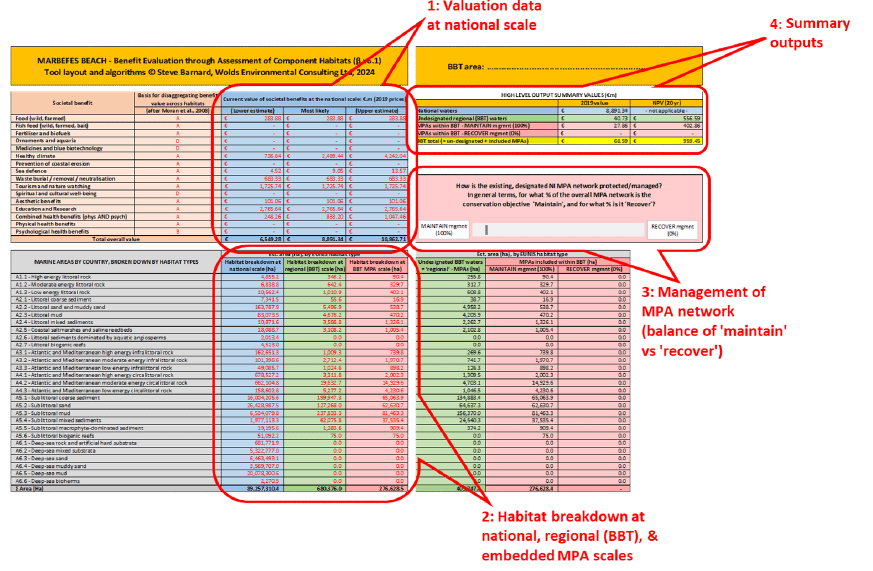
- Input data: Requires estimates of the value, at the national scale, of each of 14 societal benefits arising from natural capital, coastal/marine habitat makeup (EUNIS habitat breakdown) at national and local scales.
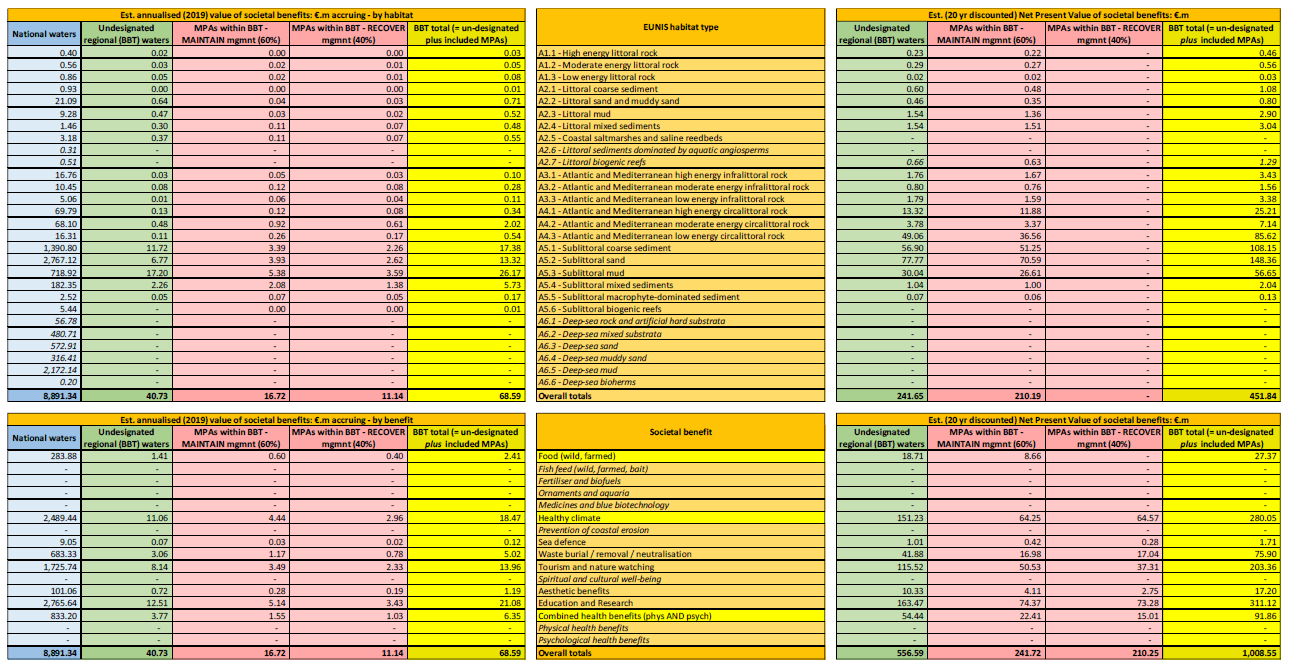
- Output: Predicted values, at the local scale, of 14 societal benefits arising from natural capital.
- Target users:
- Location tested: Applied acrossBroad Belt Transects (BBTs) in MARBEFES (case study locations
- Level of uncertainty:
- Version: β v6.4.01 (current version, but still in final development stages so may change)
- Publication:
- Rights: Tool layout and algorithms © Steve Barnard, Wolds Environmental Consulting Ltd, 2025
- Difficulty level of implementation: Easy
- Skill required (for method use): Moderate
- Authors: Steve Barnard
- Tool contributors: Daryl Burdon, Jon Atkins
- Project general coordinator:
- Project Scientific manager:
- Project manager:
- Burdon, D. et al. (2024) Linking habitat extent to economic value: A hierarchical methodology for valuing societal benefits provided by marine natural capital. Ecological Economics, 224, 108316. DOI: 10.1016/j.ecolecon.2024.108316
- Name: Steve Barnard
- Organization: IECS
- Email: barnard@iecs.ltd
BEACH (Benefit Evaluation through Assessment of Component Habitats) – B4M
BEACH4MARBEFES represents the operationalising of a published methodology for estimating the spatial value of the marine environment at sub-national scales. It integrates recent developments in natural capital accounting with developments in the spatial mapping of marine habitats, and is informed by an understanding of the links between habitats and ecosystem services.
It enables economic values to be estimated at sub-national scales, that is, those scales at which management interventions, such as the designation of MPAs, are often applied.
The development of the BEACH4MARBEFES tool facilitates the transfer of national scale societal benefit to the smaller scales of component habitats and sub-regions across the MARBEFES project’s case-study sites (Broad Belt Transects, BBTs).
In summary, the methodology underpinning the tool realises the transfer of values by:
(1) disaggregating national-scale benefit valuations according to the relative abundance of each constituent EUNIS (level 3) habitat type, and the intrinsic value of each habitat type for each societal benefit stream as assessed by Potts et al. (2014) allied with a straightforward conversion from semi-quantitative ordinal data to quantitative, ratio-scale data;
(2) subsequently re-aggregating the derived ‘transfer’ values for each specific habitat/benefit combination on the basis of the extent of each constituent EUNIS (level 3) habitat type present within discrete target areas across a range of possible scales within a given regional/local marine area; before
(3) producing derived annualised valuations for societal benefits at the new (target) scale (e.g. BBT).
- Availability / URL: Runs under Microsoft Excel ®in Windows OE