- Category: Other
- Subcategory:
- Tool Type : Genetic tool
- Input data: Water and sediment samples
- Output: Species presence
- Target users: Scientists and Practitioners
- Location tested: Artic Sea and Porsanger, Norway, Irish Sea and Galway Bay, Ireland, Sardinia, Italy and Crete, Greece
- Level of uncertainty: Probabilistic presence of species
- Version: Seascape handbook D3.1
- Publication: Only internal
- Rights: Not sure – EU Horizon Europe Grant Agreement no. 101060937 ??
- Difficulty level of implementation: Easy, Moderate or Complex
- Skill required (for method use):
- Authors: Task Leader: Jens Carlsson, Jeanette Carlsson and Dr. Panagiotis Kasapidi
- Tool contributors:
- Project general coordinator: Jan Marcin Węsławski
- Project Scientific manager: Marie Nordstöm?
- Project manager: Joanna Przedrzymirska-Ziółkowska
-
- Keklikoglou, P. et al. (2016). ICES Journal of Marine Science – DOI: 1093/icesjms/fsw219
- Name: Jens Carlsson
- Organization: University College Dublin
- Email: jens.carlsson@ucd.ie
- Name: Panagiotis Kasapidi
- Organization: HCMR
- Email: kasapidi@hcmr.gr
Genetic tools for environmental monitoring (eDNA)
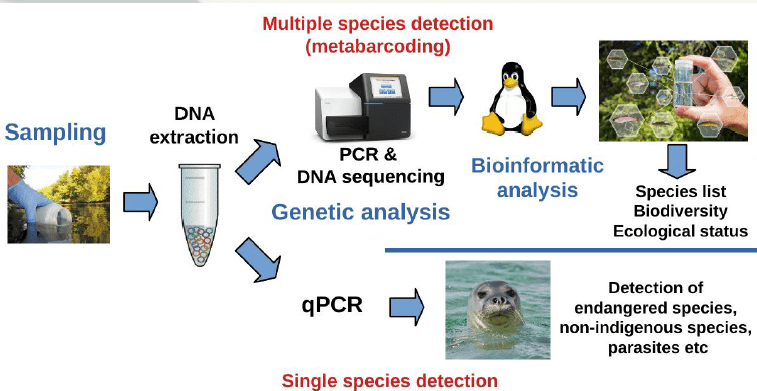
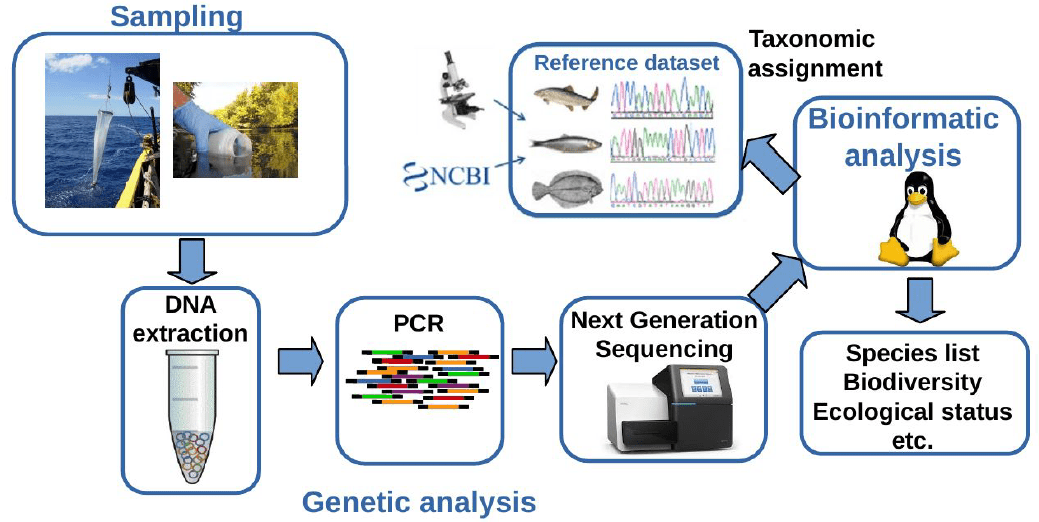
Environmental DNA (eDNA) is a molecular ecology tool used to detect and monitor organisms by analysing genetic material they release into the environment. DNA shed through skin cells, mucus, faeces, or gametes can be collected from water, soil, sediment, or air and analysed using techniques such as PCR and next-generation sequencing.
As a non-invasive and highly sensitive approach, eDNA enables species and community-level biodiversity assessment without the need for direct observation or capture. It is widely applied in biodiversity monitoring, early detection of invasive species, monitoring of rare or endangered taxa, and assessments of ecosystem health and water quality.
By providing efficient, scalable, and standardised species detection, eDNA enhances environmental monitoring, conservation research, and ecosystem management, supporting evidence-based decision-making while minimising ecological disturbance.
URL / Availability: N/A