
- Category:
- Subcategory:
- Tool Type :
- Input data:
- Output:
- Target users:
- Location tested:
- Level of uncertainty:
- Version:
- Publication:
- Rights:
- Difficulty level of implementation: Complex
- Skill required (for method use):
- Mack, L. et al. (2019). Deliverable 2.1. Land2 Sea project. Storylines and scenarios for the case study catchments. Available as an accompanying document in this tool box. MARBEFES toolbox developer please note that this is available in the MARBEFES WP5 Nextcloud folder – please take it from there and make it available in the toolbox.
- IPCC (2023): Summary for Policymakers. In: Climate Change 2023: Synthesis Report. Contribution of Working Groups I, II and III to the Sixth Assessment Report of the Intergovernmental Panel on Climate Change [Core Writing Team, H. Lee and J. Romero (eds.)]. IPCC, Geneva, Switzerland, pp. 1-34, doi: 10.59327/IPCC/AR6-9789291691647.001
- Name: Tasman Crowe
- Organization: University College Dublin
- Email: tasman.crowe@ucd.ie
Scenario Downscaling for Management Planning – Alternative Futures
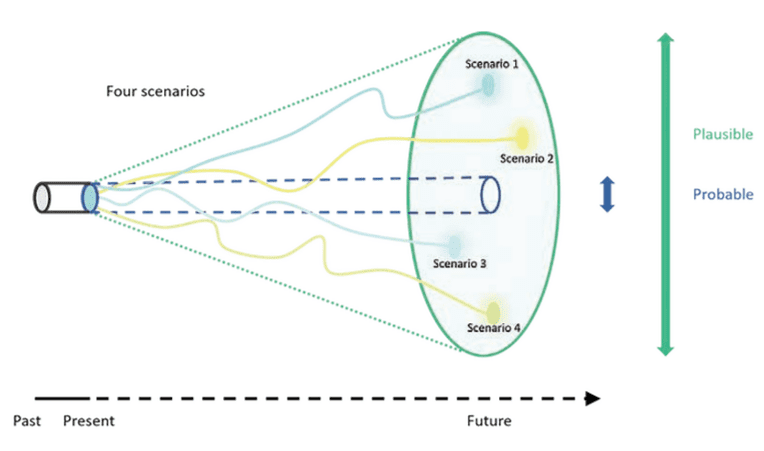
Scenarios are widely used and with several purposes (see the Belmont-Biodiversa handbook available here).
Fundamentally the objective of using scenarios in the context of marine environmental policy and management is to explore some of the range of possible futures rather than focusing only on the current set of challenges of most concern. It can be considered a thought experiment to help promote and inform contingency planning for an uncertain future.
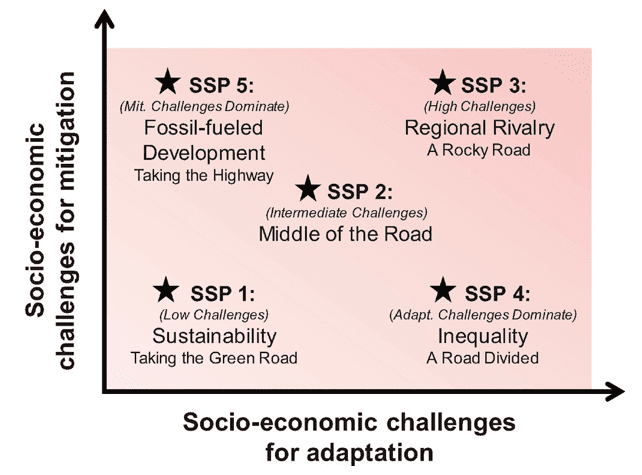
A range of high-level scenarios of alternative potential futures have been developed by a number of organisations. Although the framework proposed here could be used with any scenarios, we focus on three of the Shared Socioeconomic Pathways presented in the IPCC’s 6th Assessment Report in 2023.
Each of these scenarios is accompanied by a storyline which outlines the kind of future anticipated under it, in terms of societal norms, economic activity and geopolitical trends. The storylines are framed in global terms. In order to be applicable to local or regional policy and management planning, it is necessary to ‘downscale’ scenarios to the specific local or regional context in question.
Note that the process is not about deciding which of the scenarios is more likely to occur. The intention is to imagine how circumstances might change if each of them does hypothetically occur, as an illustration of the range of possible futures.
Using this approach it is possible, for example, to assess whether certain causes of ecosystem change are consistently important under several possible future scenarios. If so, these should perhaps be prioritised for management intervention because managing that activity or pressure is likely to continue to be important even if circumstances change in the future.
Scenarios can also inform thinking about how the ‘receiving environment’ for possible planned management and policy interventions may change in political, social and economic terms, making it more or less likely that a proposed intervention would be (a) adopted and (b) effective.
An explanation of the tool itself and instructions on how to use it are provided in the Explanatory Notes sheet within the tool itself.
Other tools available in the MARBEFES tool box can also be used in conjunction with scenario downscaling to help explore potential changes in biodiversity, threats to biodiversity and consequences of the changes for society.
- Availability / URL: Tool provided to Lifewatch as an excel spreadsheet. Could be web-enabled or provided as a download.