Category: Societal / Ecological
Subcategory: Stakeholder engagement – Structured Surveys
Tool type: Structured participatory survey (Likert-scale scoring system)
Input data:
-
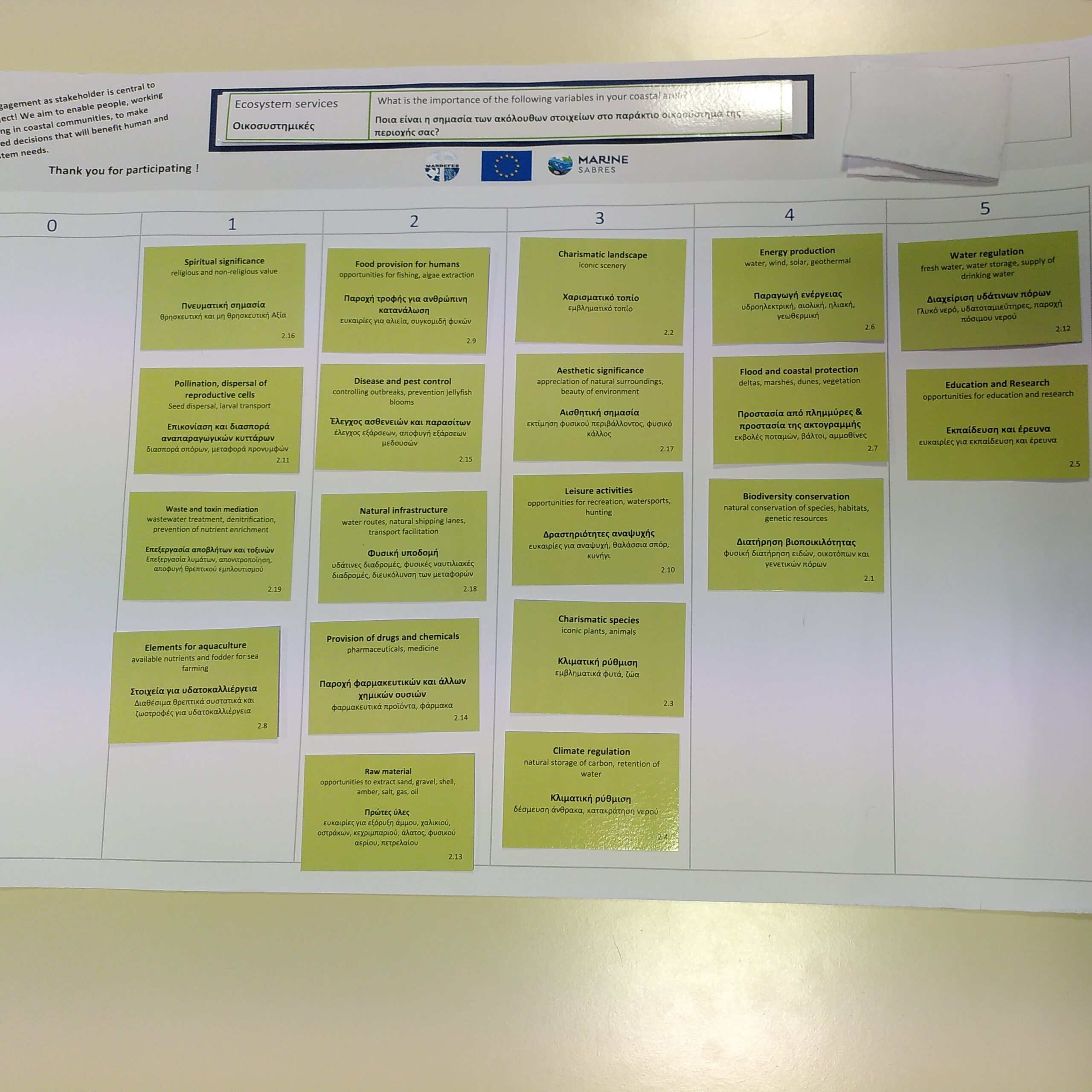
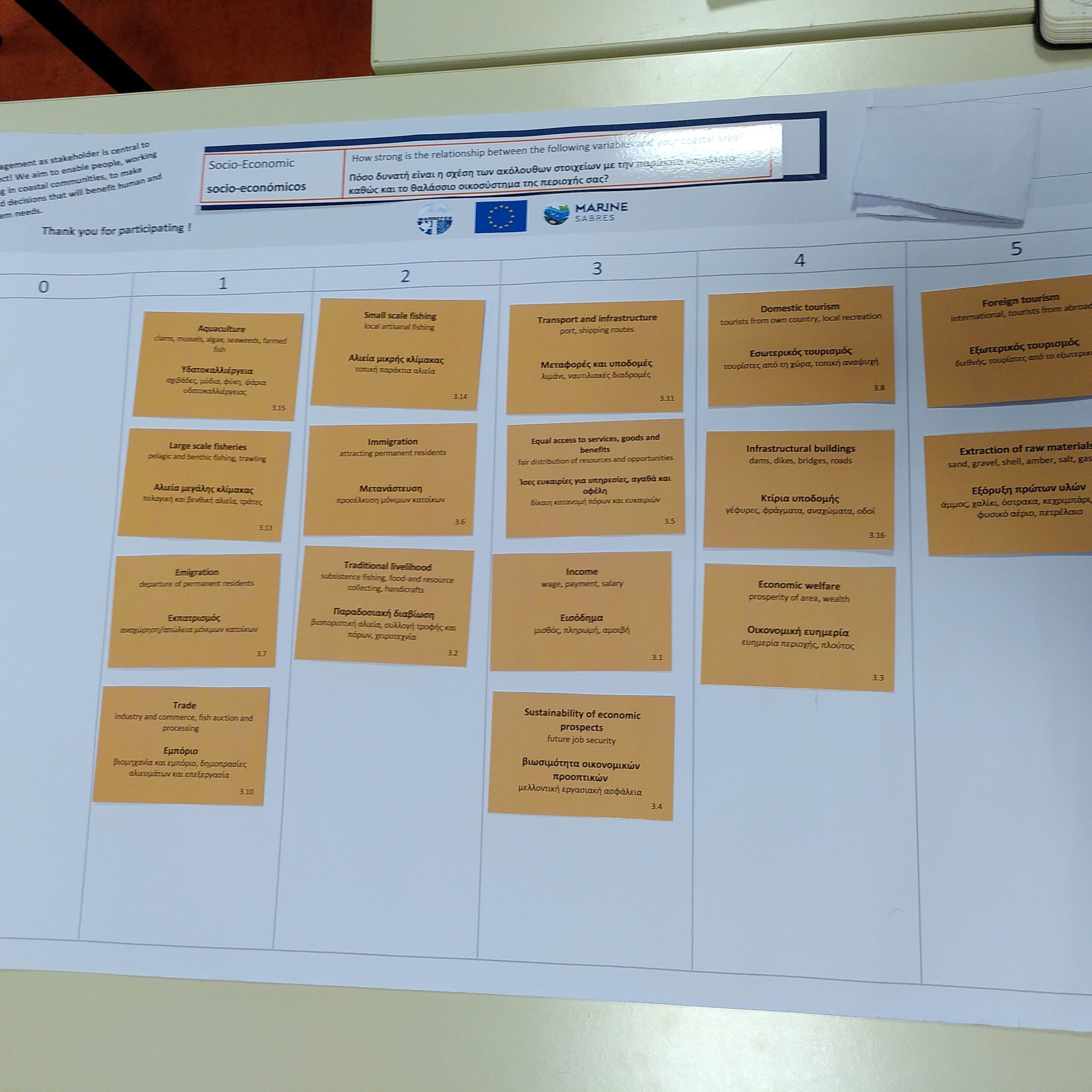
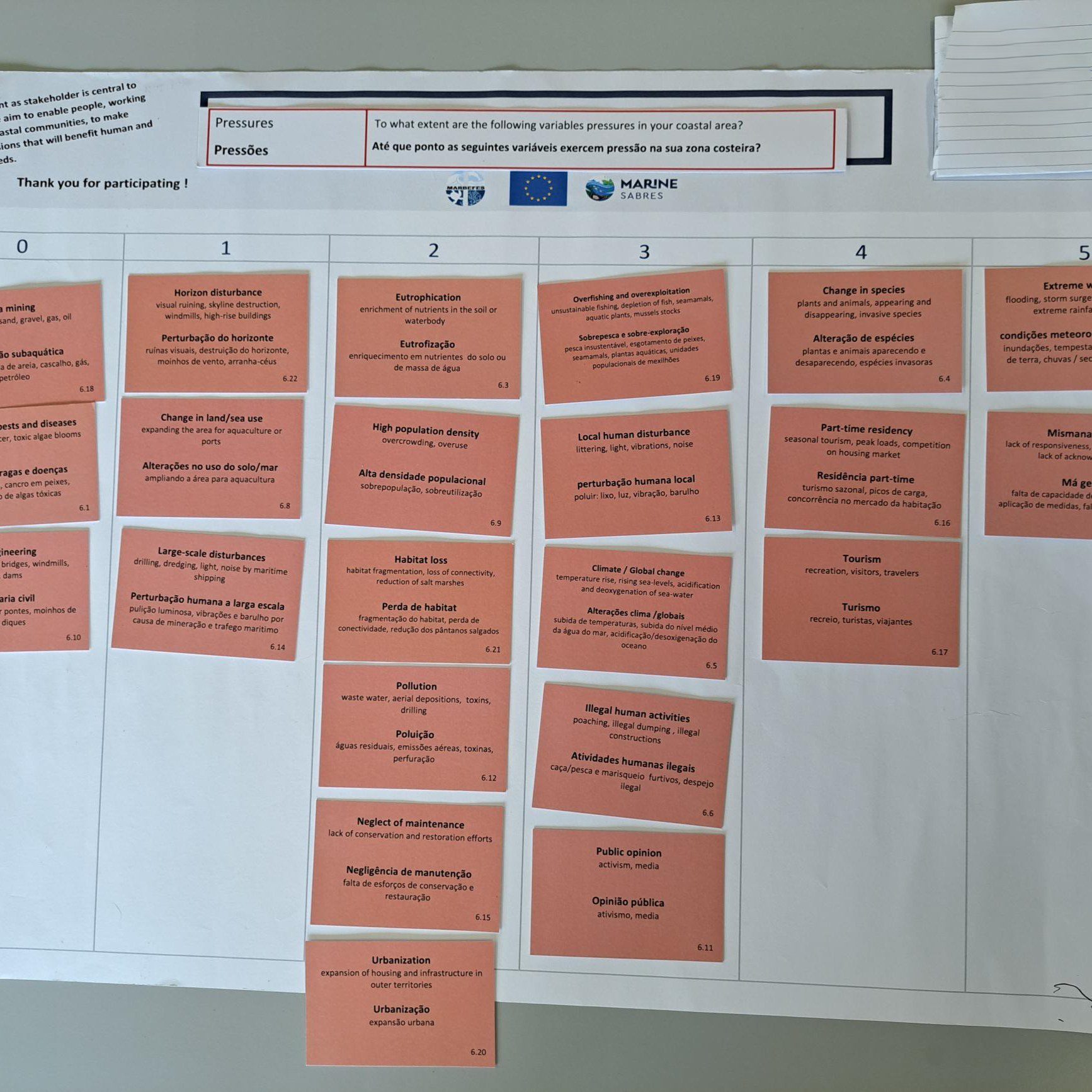
Predefined cards with variables (ecological, socio-economic, cultural, governance, pressures)
-
Stakeholder scoring (Likert scale 0–5)
-
Informed Consent forms and metadata (name, profession, date)
Output:
-
Ranked datasets of variables (importance, presence, pressures)
-
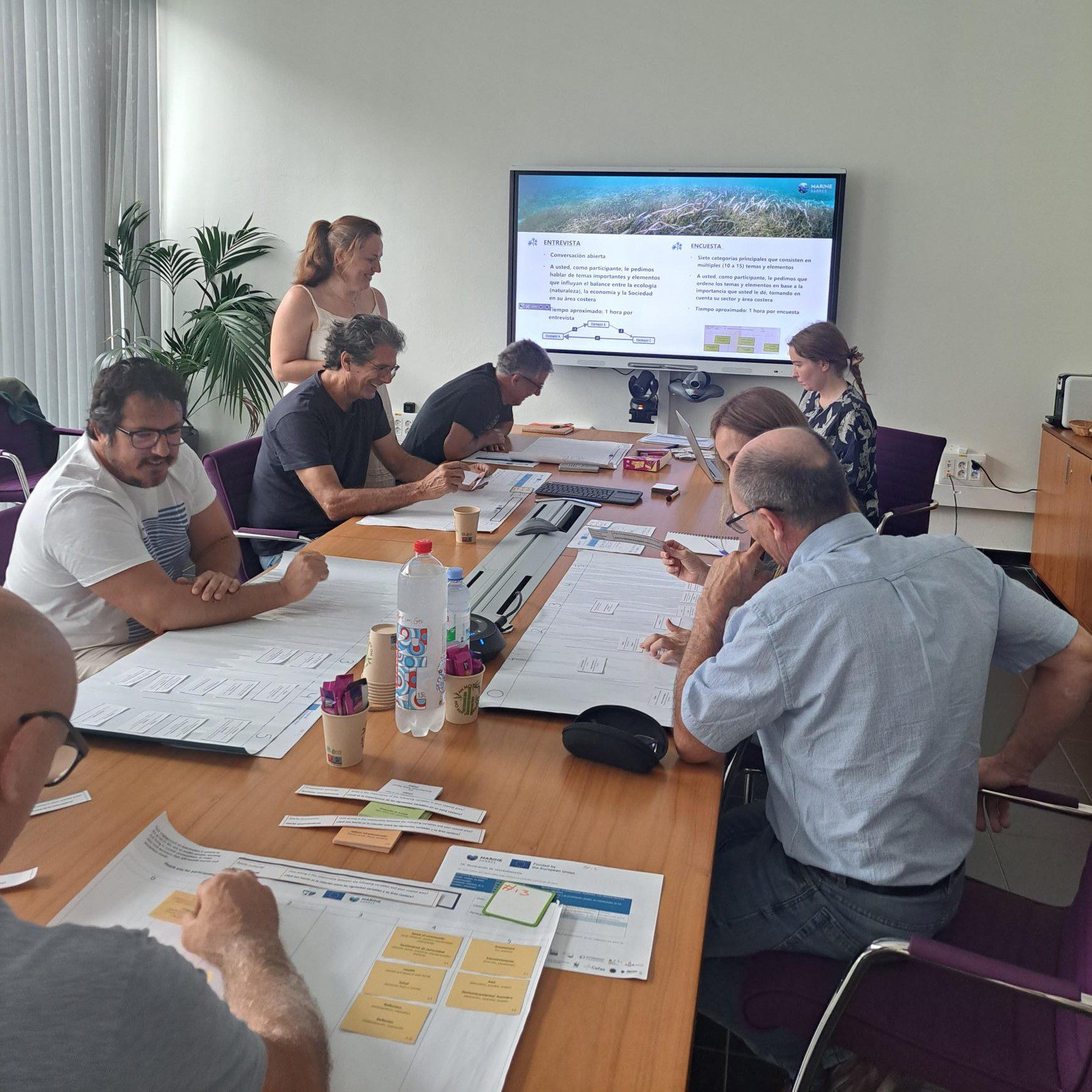
Visual survey sheets and photos
-
Statistical analyses (e.g., PCA, heatmaps via ClustVis)
-
Comparative insights across sites and stakeholder group
Target users:
Researchers, policymakers, practitioners, stakeholders, and citizens engaged in coastal and marine management
Location tested:
-
North Spitsbergen
-
South Spitsbergen
-
Archipelago Sea
-
Lithuanian Coast (Curonian Lagoon)
-
Gulf of Gdansk
-
Belgian Coast (Dogger Bank)
-
Irish Sea
-
Southern Gulf of Biscay
-
Balearic Islands (Menorca Channel)
-
Sardinia (Oristano)
-
Gulf of Heraklion
Technical details:
-
Version: Draft Guidance 2023–2025
MARBEFES_WP1_Guidlines_for_Stru…
-
Publication: MARBEFES WP1 Structured Surveys Guidelines (internal deliverable)
-
Rights: EU Horizon Europe GA no. 101060937 and UKRI GA no. 10048815
-
Lead institution: HuFoSS (Human Factors of Sustainable Seas)
-
Key contributors:
-
Prof. Dr. Herman Hummel
-
Vivièn Laros
-
Hanie Matajinimvar
-
Rob Segeren
-
Dominga van der Vliet
-
Jane van Wechem
-
- Hummel C, J van der Meer, K Timmermans, H Hummel, 2022. The use of Fuzzy Cognitive Models to strengthen stakeholder participation in the management of Protected Areas: the Dutch Wadden Sea. In: C. Hummel. The use of the Ecosystem Service approach in Protected Area management. PhD thesis, VU Amsterdam, pp 79-102.
- Kosko, B. (1986). Fuzzy cognitive maps. International journal of man-machine studies 24(1): 65-75.
- Kosko, B. (1988). Hidden patterns in combined and adaptive knowledge networks. International Journal of Approximate Reasoning 2(4): 377-393.
- Kosko, B. (1993). Adaptive inference in fuzzy knowledge networks. In Readings in Fuzzy Sets for Intelligent Systems (pp. 888-891). Morgan Kaufmann.
- Likert R, 1932. A technique for the measurement of attitudes. Archives of psychology.
- Özesmi, U. & Özesmi, S. (2003). A participatory approach to ecosystem conservation: fuzzy cognitive maps and stakeholder group analysis in Uluabat Lake, Turkey. Environmental management 31: 0518-0531.
- Özesmi, U. & Özesmi, S.L. (2004). Ecological models based on people’s knowledge: a multi-step fuzzy cognitive mapping approach. Ecological modelling 176(1-2): 43-64.
HuFoSS team
-
Prof. Dr. Herman Hummel Herman.hummel@hufoss.nl
-
Vivièn Laros Vivien.laros@hufoss.nl
-
Hanie Matajinimvar hanie.mataji@hufoss.nl
-
Rob Segeren Rob.segeren@hufoss.nl
-
Dominga van der Vliet Dominga.vandervliet@hufoss.nl
-
Jane van Wechem Jane.vanwechem@hufoss.nl
Structured Surveys
Using structured interviews and Fuzzy Cognitive Modelling (FCM), stakeholders identify the ecological and socio-economic elements that are important for their sector in their area. These elements are written on cards and placed on a poster, after which the participant connects the elements that influence each other, and indicates the strength of the connection (on a scale from -5 to +5).
What is the purpose of the tool?
The purpose of the tool is to obtain the perception of stakeholders on the most important socio-economic and ecological variables in their area, and the way they interrelate to (i.e. influence) each other. Such insight is needed in order to be able to integrate stakeholders’ views and opinions in environmental policy and management tools.
Who uses the tool?
This tool is to be used by 1) the interviewer leading the interview, and 2) the stakeholders, as PA managers or policy-makers, who can use the outputs by focusing on the most important elements.
How to use the tool?
To conduct structured interviews with Fuzzy Cognitive Modelling (Kosko 1986, 1988, 1993), the following should be prepared:
- The team, which should consist of an interviewer and a note-taker
- Stakeholders:
- At each location, about 15-20 stakeholders can be interviewed in 3 days.
- Stakeholders may be represented by more than one person, i.e. with one or two colleagues. They will count as one stakeholder.
- Interview amenities for FCM:
- 1 Magnetic whiteboard sheet, 100cm by 45cm, • 30 Magnetic whiteboard ‘sticky-notes’, different colours • Whiteboard markers in various colours • Paper notebook and pencils • A device to take photos with (mobile phone)
- Make sure the interview takes place in a calm environment (possibly at the residence/institute of the stakeholder) with a cleared table, and the participant(s) feel comfortable and are familiar with the procedure.
- Let the participants fill in an Informed Consent Form just before starting the interview.
The interview consists of three phases and takes about 1 hour.
- First phase (15-30 minutes):
- The central question, on which the FCM will be based, is introduced.
- Stakeholders are asked to share their views regarding the central question, i.e. in MARBEFES, on what are the most important elements for their sector in the balance between the ecology (nature), economy, and society in their coastal area, and what are the influences and pressures on this balance.
- There will be no interference by the interviewer, only gently guiding the interview by repeating what has been said, without steering the conversation.
- The note-taker writes down the most important elements mentioned as keywords on paper (10 to 30 words), taking care not to distract the participant(s).
- Second phase (5-10 minutes):
- The stakeholder can take a short break.
- The interviewer and note-taker agree on the list of keywords and write them down on separate magnetic notes. These notes are then placed on the large magnetic sheet in an open oval shape. Try to pre-order them into 4 categories.
- On the left: Green for ecosystems and nature.
- In the middle: Blue for the blue economy, and Orange/Yellow for social, governmental, and cultural keywords.
- On the right: Red for pressures.
- Third phase (20-30 minutes):
- Consult the participant(s) on the final placement of the magnetic notes. If they want to add a keyword or merge two or more words, this is allowed.
- Note the name, date, and profession of the stakeholder on the magnetic sheet.
- Take a picture at this stage (to prevent coincidental loss of keywords by accidentally whipping them out by touching and repositioning them).
- Take care to explain the procedure again to the participant.
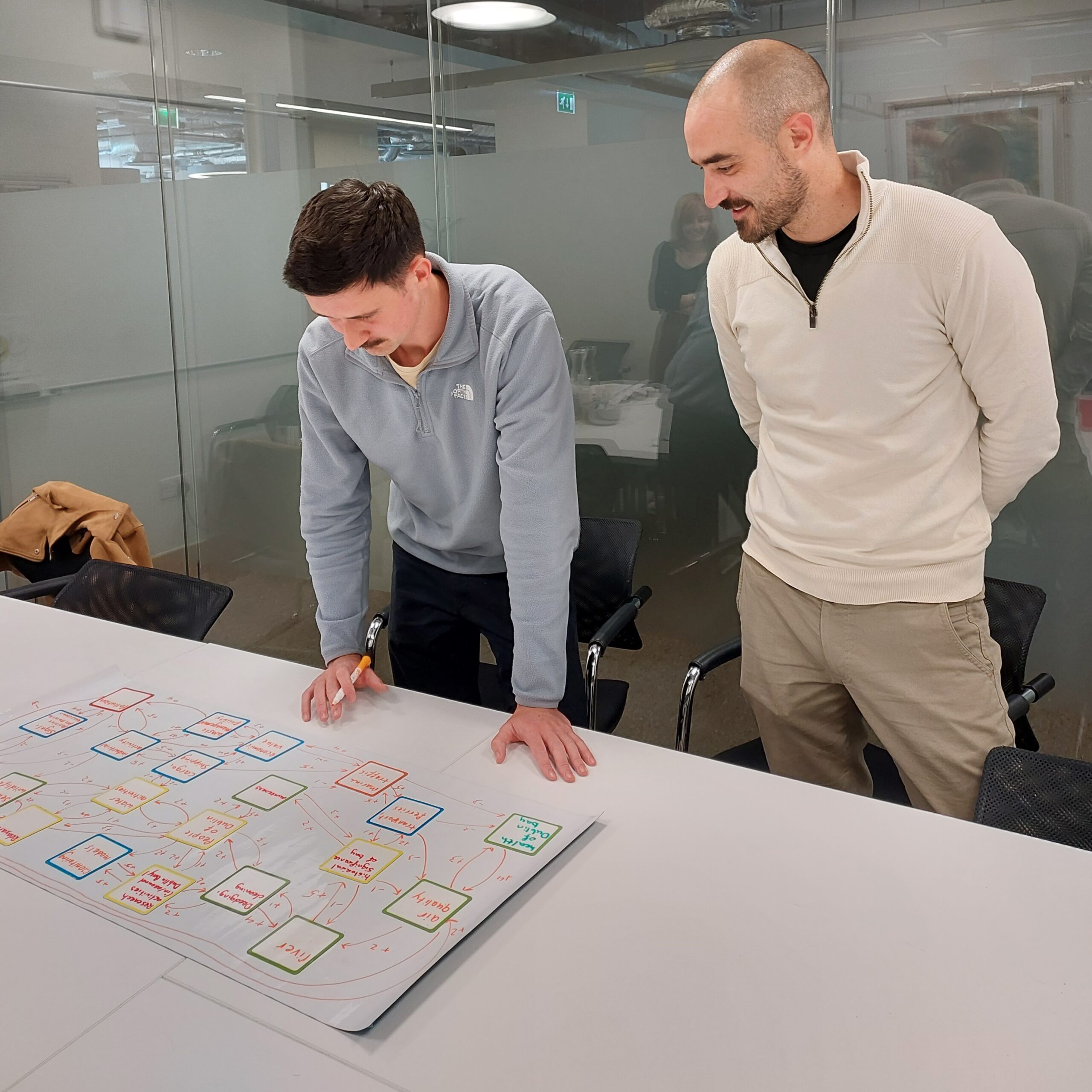
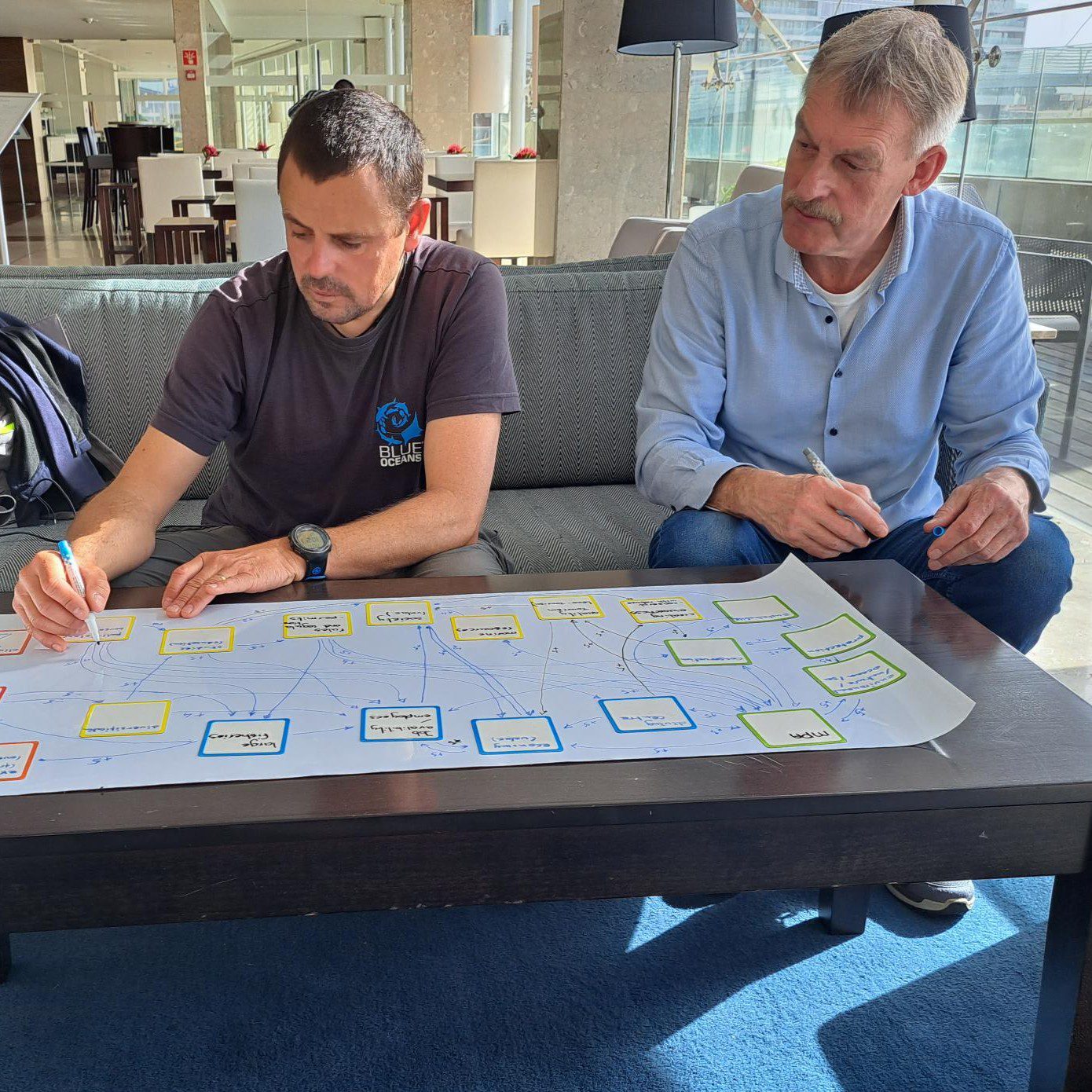
- The stakeholder is asked to link the keywords they mentioned that influence each other and rate the strength of these relationships. They draw arrows from the influencing keyword to the keywords that are influenced to indicate relationships between them, which can be either positive or negative influences. See Fig.1 for an example of this.
- Relationships should be ranked on a scale from -5 to +5 (1 is a very low influence, 5 is a very strong influence) (Likert 1932).
- Start with the most important keywords and relationships, according to the participants. When all relevant relationships have been pointed out with arrows and ranked, the exercise is complete, and the interview is finished.
- Take a picture of the completed sheet, don’t forget to include the name, date, and profession of the stakeholder.
- Save all pictures carefully and email them to yourself.
After the interviews, the Fuzzy Cognitive Maps with interrelated elements as revealed by the stakeholders (see Fig.2) will then be processed as follows:
- Harmonize between consultations the various synonyms for factually similar elements. For example, biodiversity, species diversity, and species can together be called biodiversity.
- Based on the harmonised elements, a set of indices can be calculated to characterise stakeholders’ FCM networks, and to indicate similarities or differences within and between individual stakeholders’ FCM networks (Özesmi & Özesmi, 2003, 2004, Hummel et al 2022).
- A practical set of indices may form the core for further development of tools, discussions, and management, being:
- the frequency an element was mentioned among stakeholders.
- the number of connections (vectors) from or to an element.
- the centrality, i.e. the average strength of elements, is connected to other elements.
As a guiding rule, one can take a cut-off level for the indices to decide which elements are sufficiently important to be taken into account for further inclusion in analyses, planning, or management. For example, the frequency of an element has to be at least 50 % among the interviews taken in a research area, or an element must have a number of vectors that is equal to or higher than 50 % of the highest number from/to an element obtained in that area.
Availability / URL:
-
Not available as an online tool; implemented as field survey protocols and datasets.
-
Guidance and feedback slides exist as internal MARBEFES documents.